


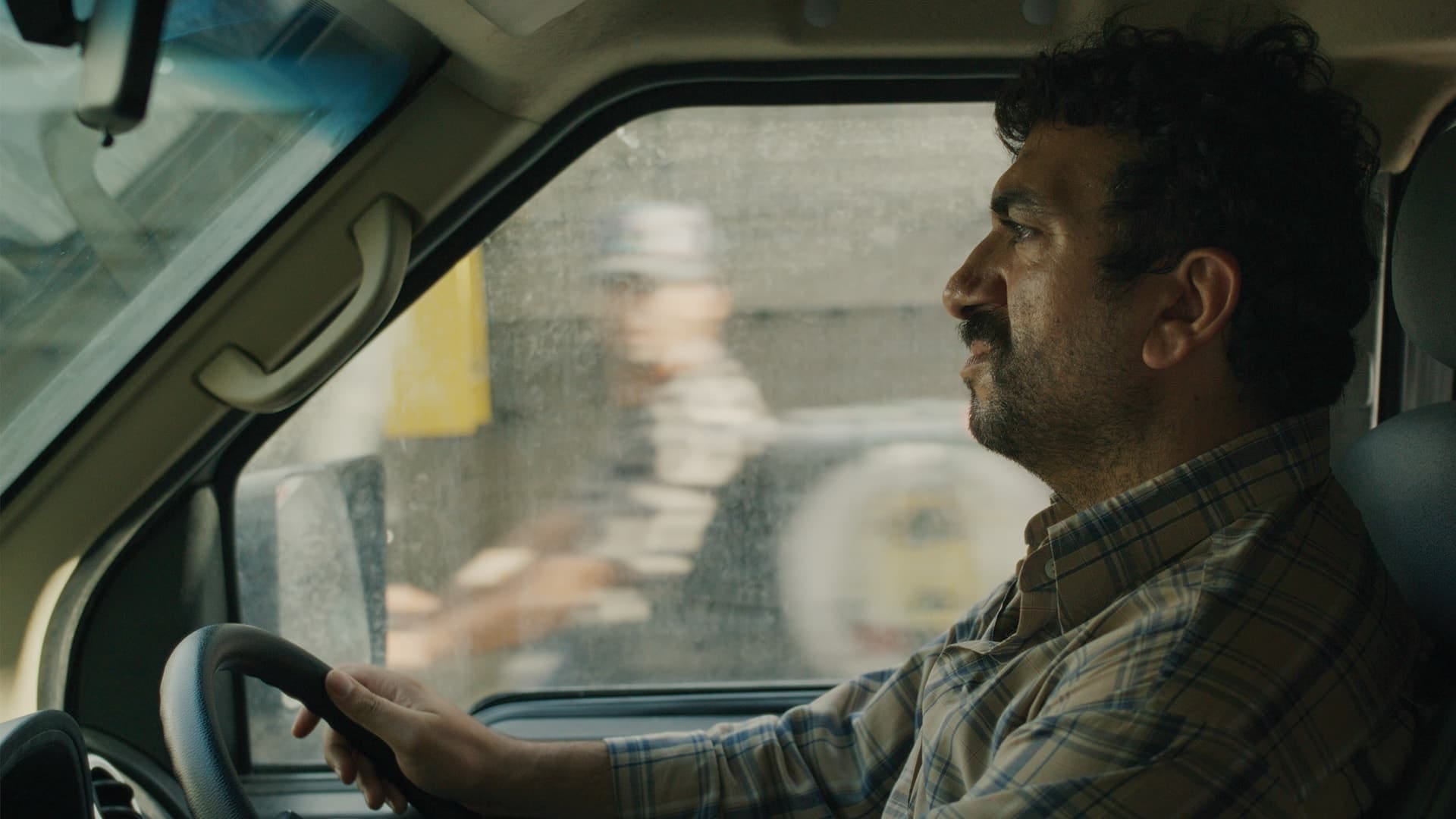
The film opens in the dark of night in the intimacy of a family in a car. A husband and wife, she dressed in a hijab, sit in the front seat. In the back their young daughter springs to life dancing and singing to a modern-sounding pop song. The father asks the daughter to be quiet lest they disturb anyone. It’s a dark night without streetlights and she mentions he makes her be careful at home, even though they don’t have neighbors or see people. It’s a small bit of dialogue, but it feels important. Are they hiding? If so, what are they hiding from?
The vehicle jumps and crunches against something, the whine of a dog is heard. They stop and the daughter starts crying. The man speaks almost as if pleading, it was just an accident.
The vehicle is damaged and sputters and stops. With luck they are near some sort of mechanic’s shop and a man agrees to help the family. Another is inside, distracted and on the phone. Something changes when he hears the voice of the husband (Eghbal) speaking and asking a question. He (Vahid) conceals his voice and face and responds. Our point of view shifts, the family drives away, and we stay with Vahid who follows close behind.
As the perspective shifts one becomes cognizant of the filmmaking and storytelling. Why make a change now? What importance does it have? These are the types of questions that can only be answered or revealed at the end of a film, yet they are worth making note of while on the journey. It’s one of the reasons why films of quality are worth a second viewing or review. It’s one of the many things I enjoy about the art of filmmaking. Choice, defined by what we hear or what we see, combined with the written dialogue, is what makes film special and worth considering.
Here, those choices and decisions are made by Jafar Panahi, a filmmaker I knew by name, but had never spent any time with. Instead my only experience with Iranian filmmaking has been through Asghar Farhadi and Abbas Kiarostami. Not that I’m versed in either’s full filmography. What’s interesting about Panahi is that in many ways he’s known, and especially by me, for his political life.
Jafar Panahi has been in and out of Iranian prison due to the political nature of his cinema. In 2010 he was given a 6 year sentence and banned from making films for 20 years. A ban famously flouted in This is Not a Film as he continued his craft amidst appealing and fighting legal battles with the Iranian government. Even now he is under threat. It Was Just an Accident was secretly filmed in Iran. In a strange act of courage, Panahi has returned to his home country. An active warrant for arrest hangs above his head. With the current chaos of war, his fate remains unknown.
It can be enlightening to understand the background of a filmmaker when approaching their work. I don’t always feel it is important, but when the film is political or socially bent, the background provides a platform for how to approach it. Though, It Was Just An Accident stands as such a powerful act of storytelling that it can eschew the scaffolding of context.
It’s an age-old debate and discussion - the art and the artist. Can we, and should we, separate them? Or, are they inextricably linked? I don’t have an answer to the question, and with Panahi it’s an easier discussion. He’s not a monster, guilty of terrible acts of hate or oppression. He is the oppressed and hated. He is the artist fighting for freedom of expression and uses his art to highlight real acts of savagery and injustice. I think the art should be able to stand on its own without the artist. It’s only then, when it has transcended, and is worth consideration, debate, and spilled ink - should we pause to interrogate further.
Back in the world of the film, in Vahid’s point of view, we see him inexplicably jumping Eghbal on the street and wrestling him into the back of his van. He drives out into the barren wastes of the desert - presumably outside of Tehran. Here he digs a grave and casts Eghbal into it and begins the act of burying him alive. He screams at him and we learn that Vahid was once a captive and he remembers Eghbal, under a different name, as his questioner, his torturer, an agent of evil. Yet… Vahid has doubt. He’s not quite sure, and he cannot kill without knowing. And so Eghbal is wrapped back into the trunk in the back of the van. Vahid has doubt, but he has not given up on justice.
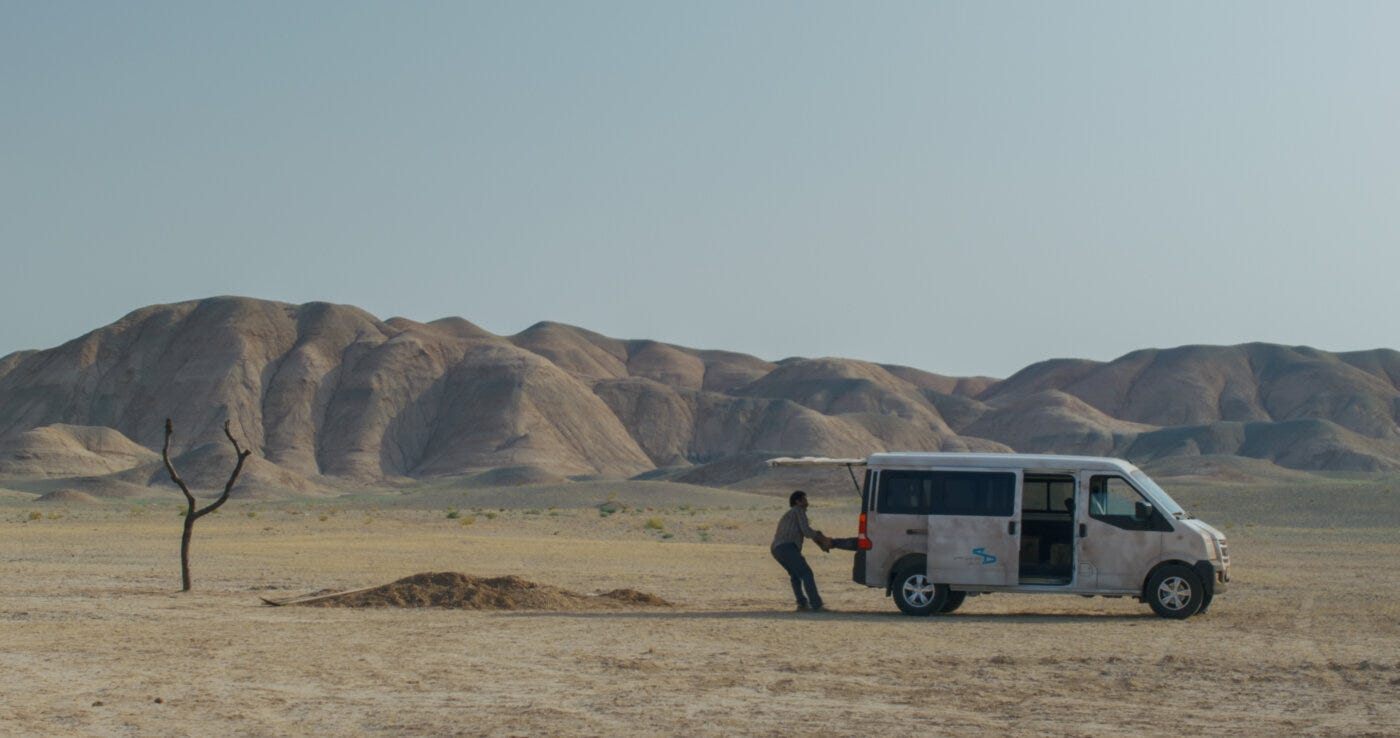
Vahid reaches out to old contacts, to those who were similarly tortured and manipulated and ruined as individuals. He finds himself a band of the similarly tortured. A photographer rebuilding her life (Shiva), a couple on the verge of their wedding day - the wife disturbed and forever altered by what happened to her, and finally a loose cannon hell bent on vengeance and destruction, lacking scruples and ready to act (Hamid). The grouping of these characters feels timeless, as if I’ve seen it before, yet cannot locate from where. It’s almost reminiscent of the odd group bumbling through the forest together in the eternal The Seventh Seal.
The emotional intensity conveyed by this group of actors is captivating. It is the anchor that pulls us deeper into the immersive experience of the film. There is verisimilitude to the words spoken and the choices made. They don’t simply serve the plot, but modulate in the sometimes confounding ways that real humanity operates.
The group examines their drugged captive. They feel his peg leg and remember the squeak it used to make as he approached. They remember his boasts of bravery from war. They recount how he made them feel the scars, how he humiliated them and frightened them and hurt them.
Doubt assails them and it is the shadow cast over all proceedings. It is Vahid’s doubt that initially stops the shovel and it is the sliver of doubt that keeps the group from casting final judgment. As in the suffocating jury chamber of 12 Angry Men, the sentence is deferred, decided, and questioned all over again. You can feel the disorientation begin to settle heavily on their shoulders. It echoes the way they are forced to live within an oppressive dictatorship where rights and freedoms are not a given and can be snatched away at any moment.
It is the very reason they have banded together under great risk - to claw back what little stability they can through a self-administered justice. Yet they find themselves in a circular trap beset by the very disorientation, confusion and fear that is imposed upon their souls by the totalitarian regime that remains nameless throughout the duration of the film. It is as if there is no escape from these forces, despite their continued insistence that they cannot operate in the same evil and destructive manner as those in power.
It is only the purity of humanity that saves this merry band from spiraling further into destruction.
It is highly suggested to have watched the film before reading further. It Was Just an Accident might be my favorite film from 2025. Please give it a chance.
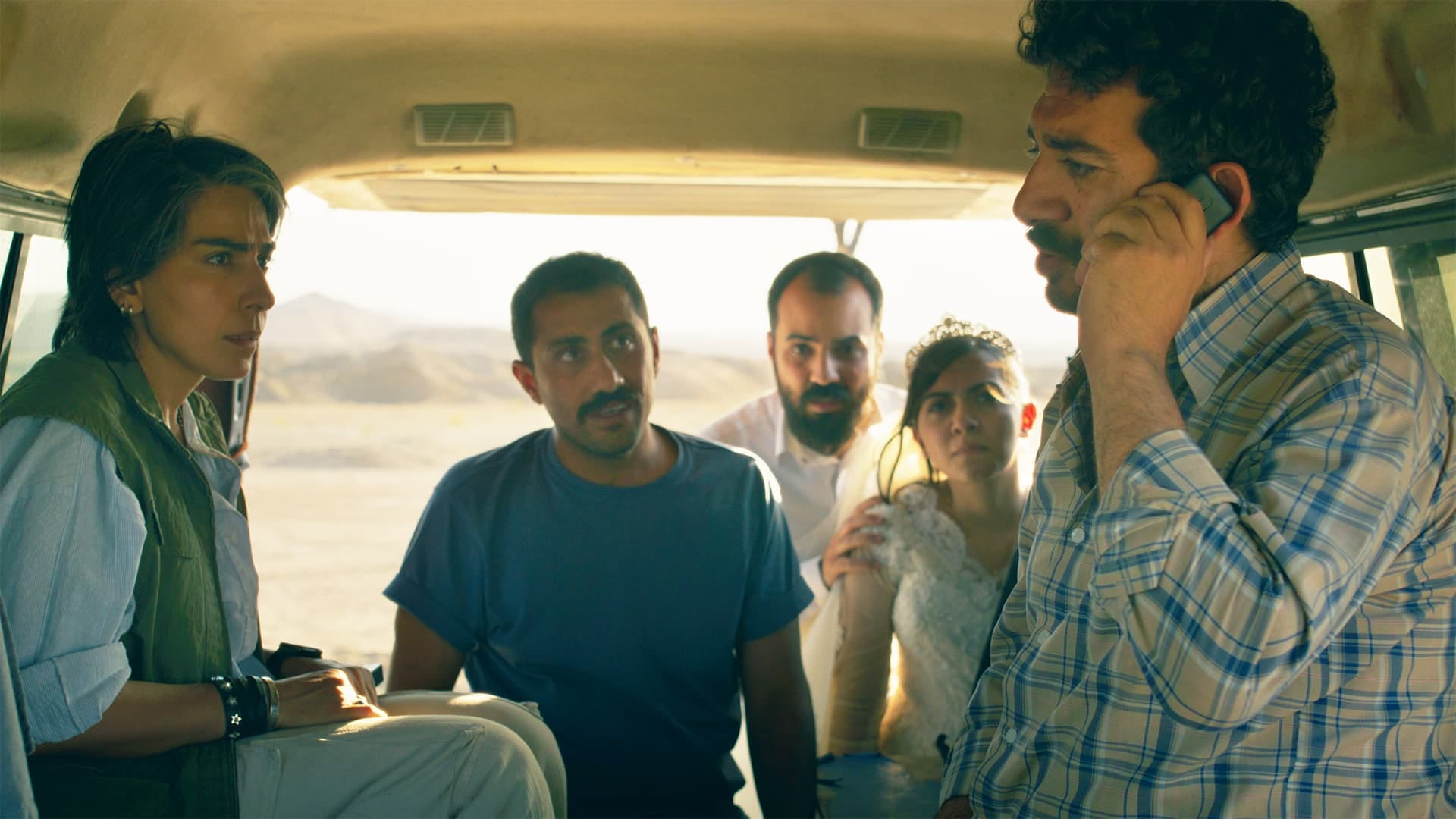
The purity of humanity comes from the weeping tears of Eghbal’s daughter calling her missing father’s cellphone and pleading for help… her mother has fainted. Vahid cannot ignore this call, he cannot say no. And so, they pick up the girl and her mother and bring them to the hospital. They stay and take care of the child long enough to learn their captive has a son.
Confronted by the birth of new life and the purity and innocence of a child, the pulsating hate driving the group towards vengeance begins to fade. Hamid and the betrothed leave. Vahid has vowed to finish what he started and Shiva follows him.
In the hills above the city they tie him to a tree and interrogate him further. Eghbal eventually breaks and confesses, but not in the way they expect. He confesses as a cog in the machine. As a man under pressure from his superiors. He confesses to following orders and doing his job.
Emotionally broken and exhausted they leave him there. They don’t have hate strong enough to kill. Though they extracted a confession, there is still doubt. Or, having seen his child and wife they cannot bring themselves to go any further. And so they leave and remain intact human beings, having not given themselves over to the latent darkness that dwells in the hearts of us all.
The film ends the next morning. Vahid turns away from us… but stops moving. He is still and hears a repetitive squeaking approach. He stands unmoving and the camera holds and holds and all we can think of and feel is the squeak and squeak, one after another, unbroken and continuous. Then without turning, it fades to black.
It was an astounding and perfect close. In the core of my being I wanted the camera to turn and reveal the face of the approaching figure. Yet I knew that by not giving us what we wanted the film entered a pantheon of greatness. Was Eghbal the sadistic torturer or wasn't he? It is with this question that It Was Just an Accident enters dialogue with other unknowns in film history. Was Deckard a Replicant, was Inception all a dream?
We know from the beginning that Eghbal and his family are somewhat conservative, his wife dresses in the traditional hijab. Yet his daughter dances to pop music. They appear secretive and concerned with alerting their presence to others, to making themselves known. What does that mean?
Watching the family in the beginning of the film makes me want to think it wasn't him. Yet, perhaps that is the point and the reason for the shifting perspective. Like in The Zone of Interest it becomes more challenging to hate and cast judgement on monsters when we see their lives and the lives of their families - realizing somehow we are still human.
I don’t know the face associated with the squeaking sound approaching Vahid. And that is what makes It Was Just an Accident so brilliant. The face doesn’t matter. The regime has no face. Hate has no face. Oppression hides behind the masks of many. The evil forces that darken our hearts and cause us to hurt each other in unfathomable ways has no face.
Currently, you can stream this film on Hulu.
Next week at The Cultural Review: Perfection