


Inès Cagnati made me cry big wet sloppy tears. They slid down my face as my chest silently heaved up and down, me still turning the pages, unwilling to stop or slow down. And then it was over, I had finished Crazy Genie. I remained in bed, lingering in the afterglow of the novel’s melodic prose, its dreamlike quality, reckoning with what I had just read.
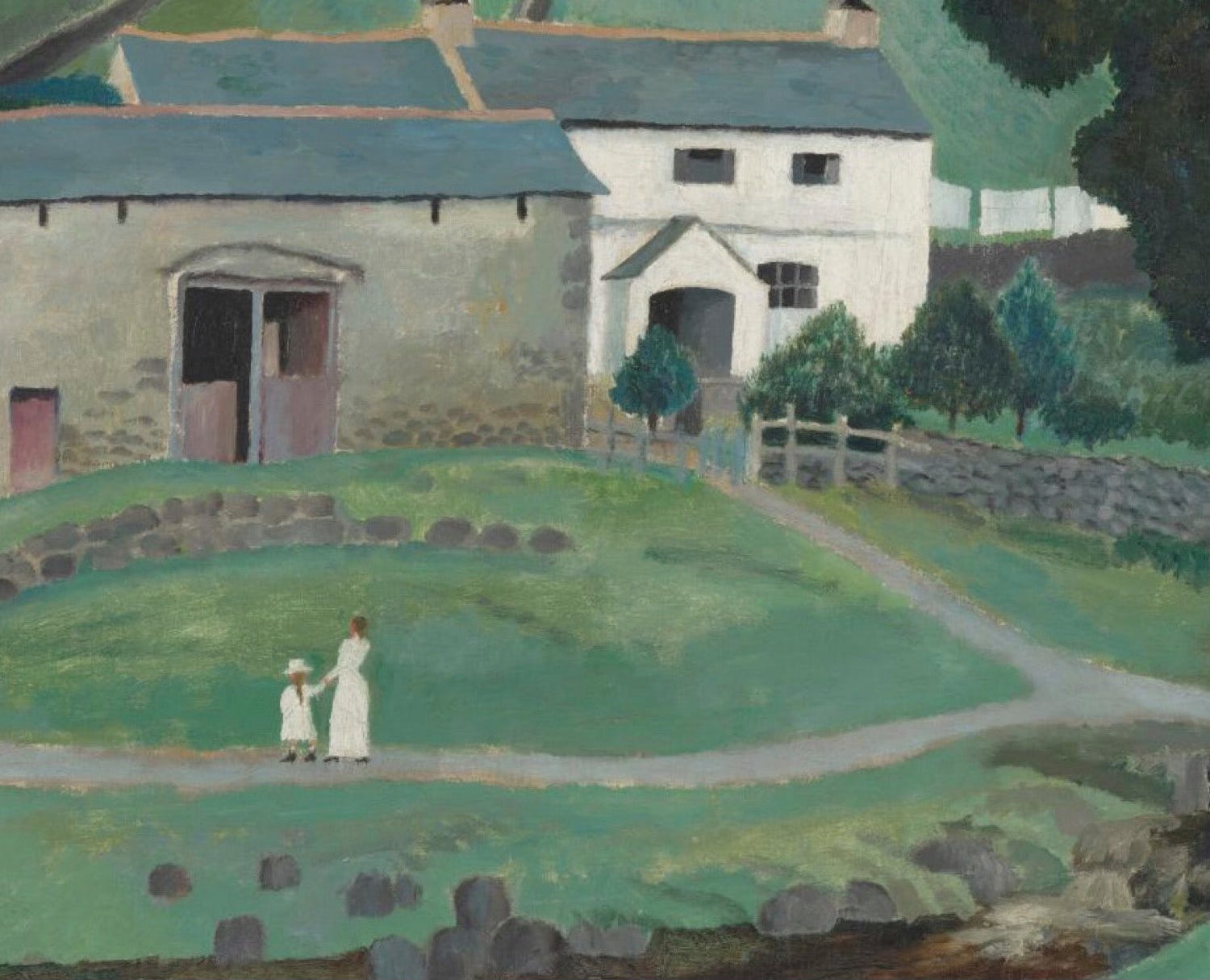
The story is told through the eyes of a child, though slightly older, looking back on her childhood in poor rural France. She lives alone with her mother in a broken down house near the willows by the river. Her mother is ostracized from the rest of the countryfolk and they all call her Crazy Genie. She spends her days working odd jobs for them, just enough to eke out a living for herself and Marie.
The story is told through short chapters, which usually span no more than two pages. These shorter small chapters are akin to a child’s bite size memory and each is a sort of connected vignette that conjures a rhythmic quality to the reading of the novel. It seems to flow through the very countryside that Marie lives in.
The rhythm is accentuated by repeated phrases that feel born of the fuzzy memory of long summers and endless days that punctuate childhood. “Get out of my hair,” from her mother, Crazy Genie, or “My Thumbelina,” from her Pierre, or the small gifts from her Grandfather “He would pull out walnuts, hazelnuts, or an apple, give them to me, saying:“Eat, little one.” The frequent similar phrases, the small chapters repeating, builds Marie’s voice and her perspective. It’s a masterful example of using all the tools of storytelling. It’s a startling reminder of what a virtuosic writer can create.
This perspective and language that Cagnati creates follows that of a child. It is simple but descriptive and dreamlike. It does not assume, it does not interrogate psychology. It shows and doesn’t tell. “I always wanted to tell her that I was waiting for her, that I was so happy, so happy that she had come back this night again, that me, I loved her. But her face was full of silence.” Because a child wouldn’t understand more than that, they would see the outward expression of emotion and react in the sensitive way children do to the moods and emotions of their caregivers.
It is this way that the prose is able to undercut the creeping in of melodrama while still telling what is a deeply melancholic and sad story. Horrible things are said, quickly and briefly, in a straightforward way. This approach accentuates rather than diminishes the evoked emotion. It also mimics what that life must have been. Terrible things happen, one moves on, what else can you do but cry? That’s life for those in rural poverty where just surviving and living commands most of your attention.
This harshness, which Cagnati does not shy away from, almost as if she believes it to be an ever present fabric to life, is undercut by the childlike gaze. It is diminished or reduced by the beautiful writing. Yet it remains, and the horror is not stopped by any of this. It occurs regardless of how she crafts something beautiful out of pain.
For Cagnati clearly believes in the everyday evil of humanity. She sees little redemption for us, and that all are complicit in the petty sins of hate and prejudice that are aimed at the downtrodden outsiders. Crazy Genie doesn’t relent, just as life refuses to relent. It is waves of onslaught with little break in between.
But the story isn’t burdensome, it is not heavy. It remains light and airy and dreamlike. My friend left phrases scratched onto a bookmark tucked into the well read pages highlighting her favorite passages, one that makes one feel a mood they would like to inhabit. “Her eyes would take on the color of tears.” Or how you might want your home to feel: “It was the time of winter dawns, when the light air, of the pale purplish shade of blue of certain lilacs, softly enveloping things.” For there can be hate in the hearts of men, there can be beauty in the world, poetry in the child. This is the contrast, the juxtaposition that Inès Cagnati weaves with such perfection.
Crazy Genie does not give her daughter Marie the love she pines for. Perhaps she is incapable and so broken herself, that to transmit palpable love is beyond what she is capable of. Yet Marie loves her anyway, fully and without judgement, in only the way a child can truly give. “I went up to her to talk to her, but her eyes were distant, and she said as usual:“Go back to the house.” And in the subsequent chapter and again and always she says the same. “I rose up towards her. She came near me with her basket on her arm and said: “So then, go back home.”
Marie was born into strife and hate. A hate that Crazy Genie’s mother, Marie’s grandmother, does not bridle. A hate she perpetuates down to her granddaughter as well, only seeing shame and dishonor and not a person, not a child or soul in need of love and care. And we know that this is how Crazy Genie, Eugénie experienced love from a mother. We see that Crazy Genie loves Marie by the sacrifices she makes, the way she fights for her future, one away from the poor rural farmsteads. But this broken love can only go so far, one who has never felt love can rarely give it. And Marie’s affection remains unanswered and unsaid, not from an unwillingness, but from an unableness.
The stuntedness of Crazy Genie’s love matches the perceived kindness and gentleness of the grandfather. He is loving and caring for young Marie, but we know how complicit he is in the pain and the suffering of Genie, and how he seems to do nothing, his head buried in books of kings long dead and gone. For he mentions how his wife did not love Eugénie, but there is no sign of action. He mentions how he is happy about Antoine. He gives Marie walnuts and apples and promises a dog that gets taken by the grandmother. This is a love without cost, a love that is easy. A love that can be turned on and turned off. Perhaps, it is the falsest of loves. Perhaps the most painful of all, for it is his inaction, his gentleness, and lack of understanding that leads to the greatest pain of all.
There is so much in this short simple story — Benoît the duck, and Rose the blind cow, Marie’s simple companions and friends from youth. The doctor’s hateful revenge, Antoine’s simple love that gives hope to a new life. The mason. The priest. The long days and nights laboring in the fields. Pierre and the islands and the hope of escape towards the perfume of frangipani. Of how: “I said nothing and I let those unbearable things happen because there was nothing to be done, no.”
Inès Cagnati’s genius, Crazy Genie should be experienced as purely and truly as one can. It should be shared and discussed and loved. One should receive texts like I did: “That was so fucking sad. Why did you do that to me?” Quickly followed by, “It was beautiful.”and also, “and completely heartbreaking.” There is nothing I can say that even remotely approximates the simple task of reading this profoundly beautiful book, please do.
You can find Crazy Genie at NYRB
Next week at The Cultural Review: A Personal Essay (aren’t they all?)
I just finished this one the day before and your review is spot-on! I was telling a friend that after the end I had this instinct to not dwell on what I'd just read because I knew by doing that I'd be swallowed up by the devastation. At the same time it's a book that doesn't leave your mind.