


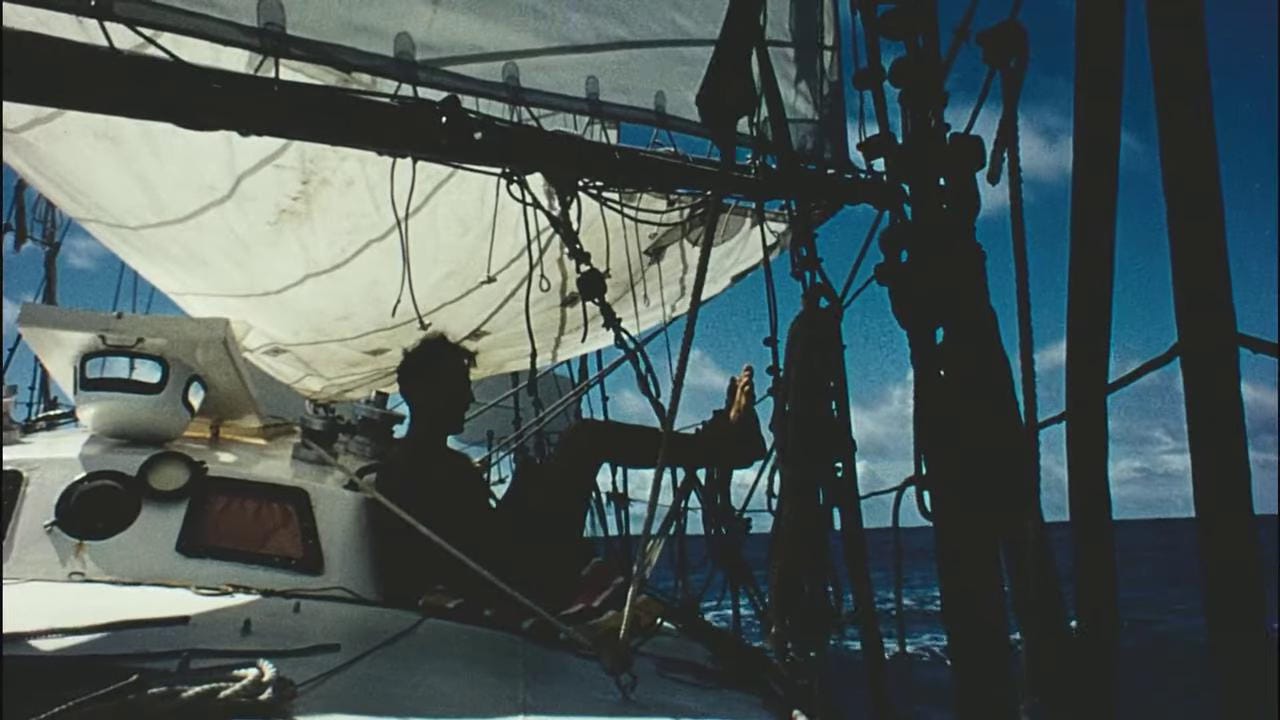
We all have silent obsessions and interests that take hold of our imaginations and refuse to release us from their grasp. The idea or the story that we cannot get out of our heads. The inspiration that drives us to write and to dream and to create. The thing that we just cannot put down. For me, it is the idea of solo circumnavigation punctuated by The 1968 Sunday Times Golden Globe Race.
Nearly twenty years ago I stumbled upon the documentary Deep Water (2006) which began my fixation. Eight men set out from the British Isles in 1968 with the goal of winning a non-stop around the world sailing race. It was staged as a public relations stunt for the newspaper and it captured the popular imagination.
Sailors could leave anytime between June and October with a prize being awarded for the first to accomplish the feat and a secondary prize for the fastest time. Of the eight sailors who set out, only three lasted long enough or sailed fast enough to compete: Robin Knox-Johnston, Bernard Moitessier, and Nigel Tetley. A fourth, Donald Crowhurst, inexperienced and desperate, stayed in the race by faking his progress through false logs and dispatches. Only one would finish the race.
Alone at sea for months at a time, what does that do to a soul? In Joshua Slocum’s Sailing Alone Around the World, the ur-text in sailing adventures, he goes 73 days without port. He mentioned this as nothing, noting that the coral reefs would keep him company. For those competing in the Sunday Times Race it would be eight to nine months.
Not only was this a feat of physical daring and adventure it was an immense test of psychological fortitude. When I spend a day alone, just a day, I can feel its effect. The U.N. Mandela Rules argue against solitary confinement for over 15 days. Isolation, however done, can have psychological consequences.
It was this mystery, these consequences which both horrified me and drew me to this story. Donald Crowhurst alone at sea, under immense stress, began to crack. The thin realities holding his mind together were swept away by the sea. His forgery, his story, a different reality, a different trip, was just the beginning. He opened his mind to a false reality, and it consumed him.
Adrift off the coast of South America, his ship badly in need of repair he plotted his re-entry into the race. It became clear that he would be in contention for the fastest time. He knew his logs wouldn’t stand up to scrutiny. The pressure built and built and failure became apparent.
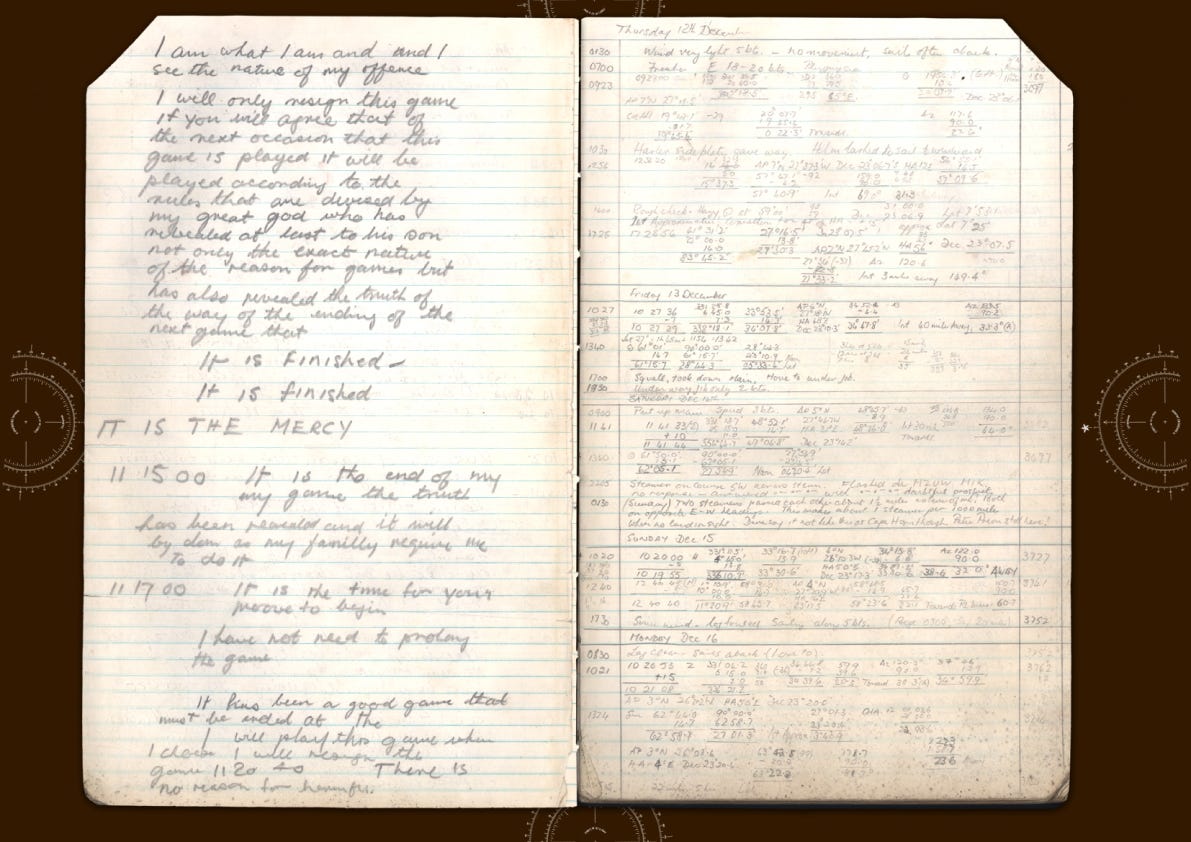
In a week’s time he wrote 25,000 words of madness scrawled into his log and journal. He descended into metaphysical ravings against God and fate. Alone at sea he was destroyed. It is there, in some manner, that his life ended. Presumably he threw himself into the ocean. His boat was found later, completely abandoned.
It is this terrifying story of a man beset by the pressures of life, launched into a desperate attempt to change his fate, and then ultimately unable to cope with his failure and destroyed that I first found so compelling. So much so that many years ago I wrote 30,000 words of an attempted and failed novel based on the idea of solitary madness at sea. On the question of what would drive a person to a choice like that. How would their wife feel, how would their family cope?
“We’ve talked about this. We have been over all of this.” Carson now grew bold and angry and the quietness of his emptiness now evaporated. Now he began to yell. “Do I have to explain myself all over again? Do I have to prove my love to you endlessly? Can you not understand, can you not fathom the depths of my soul, why I need this?”
“You need this?” Julia began to sob. “What about me? I work double shifts at the hospital. I wipe shit from geriatrics for us. I sacrifice, I do all of this for us. What are you doing? A boat ride, you need to get in touch with yourself? You need to fall in love with the world again?”
“That’s not why I’m going.”
“Then why are you?”
“Because…”
“What about Jack, Carson?”
“What about him?” Carson now felt the emptiness again. He felt every care drain from him. He looked at his wife and felt nothing. She did not understand, she could never understand.
Of course she would speak his son’s name. Of course she would bring him into this. The silence settled between them once more. Both stood on opposite sides of the dimly lit kitchen that still enjoyed the old incandescent glow of an endangered light bulb.
I never did find the answer I was looking for in those words. Perhaps one day I’ll visit them again and find my way into the mind of Crowhurst, or one like him, who is willing to leave and risk it all to be alone in the vastness of the ocean.
As a younger man my primary obsession was Crowhurst’s madness, yet I was always intrigued by the figure of Moitessier. Perhaps the most accomplished sailor of the entrants, he left Plymouth on August 22nd, nearly two months behind Knox-Johnston who departed on June 14th from Falmouth. Moitessier made fast time down to the Cape of Good Hope and was slowly and steadily gaining on Knox-Johnston, who had taken the lead.
After rounding Cape Horn the sailors would turn north back to the British Isles. They were nearly neck and neck. Moitessier would certainly win the fastest time, but he also had a chance at winning the Golden Globe, taking all the prizes. But, then he stopped.
Moitessier on the verge of sailing immortality determined that he didn’t want it, he didn’t need it, and that he would continue sailing around the world again. He left a note and the competition.
My intention is to continue the voyage, still nonstop, toward the Pacific Islands, where there is plenty of sun and more peace than in Europe. Please do not think I am trying to break a record. 'Record' is a very stupid word at sea. I am continuing nonstop because I am happy at sea, and perhaps because I want to save my soul.
Moitessier wrote beautifully about the events of the race in his memoir The Long Way. He never saw the race as a race, but as something more, as something spiritual. He is the antithesis of Crowhurst who joined in desperation for money and fame, who leveraged everything, to the point that it broke him. Moitessier sailed for sailing itself, for the purity of the sea and the earth as he mentioned at the outset of his journey; “All Joshua and I wanted was to be left alone with ourselves.”
As I think about it, both men represent a differing approach to life, almost as if the story of the Sunday Times Golden Globe Race is a parable in itself. There is the tale of money and desperation and the tale of peace and love and harmony. What happens to the man who gives it all up to live life versus the man who risks it all for money and fame? It almost feels made up.
When I first stumbled upon this story I remember being in awe of the man who gave up the riches and the fame and decided just to keep going because they wanted to. The more time passes the more I am in awe of Moitessier. The more I wish I could live in that way, to be free from all the worldly entanglements which bind themselves upon me.
Towards the end of The Long Way he writes about how he views the world. How he sees The Monster and the pursuit of wealth and progress.
The Monster has arranged things so that the hippies are accused of lots of crimes. Their crime is feeling deeply that Money is not the ultimate goal in life. It is refusing to be accomplices of a society where anything goes so long as it is legal. It is disagreeing with the physical and spiritual depredations of the race for Progress. That so many understand this is a great hope for us all.
He was not a man who gave into the desires of the world, somehow he floated above them all. It is a rare gift, the person who can live in this spirit. For not all of us can. In our dark hearts lie the desires of Crowhurst. We seek accomplishment and wealth from the world, that which matches our perceived value and skills. We seek what we believe we are owed. But life does not work in that way. It does not dole out riches by worth.
Crowhurst’s desires in themselves are not bad. To proudly venture forth into the world with creativity and bravery to achieve great things is the story of human flourishing. It is what he gave up to chase such things. That is the sin that destroyed him. It is that which we all may fall prey to and guard against. Moitessier knew of these desires, he knew of what they could take and so he turned away in an attempt to save his soul.
It was just a race, just a publicity stunt, but it became so much more. It was about man’s great accomplishments, about what we as humans can push ourselves toward. It became about what you stood for, your beliefs and morals. It became about desperation and what acts a person can be driven to in pursuit of their goals. It became a mystery of psychology and horror of what can occur in our minds. In the end it was just the sea and the gulls and the waves and the water.
What it became for me is a never ending interest. An interest that I have only begun to dive the depths of. And it is the collection of these trinkets and accessories of our minds’ interest that make this life so wonderfully worth living.
The Long Way, Sailing Alone Around the World, Deep Water
Next week at The Cultural Review: Crazy Genie