


In the corners of our minds, in the depths of our hearts, we all have special places that are treasured and held tightly in the safety of our memories. Locations tied to undeniable happiness and joy. Places of peace and rest. Where the environment somehow takes control of your essence and being and buoys your thoughts and emotions because only good things can happen in these places. These places can change and grow over the course of one’s life, but none are so powerful and lasting as those encountered during the blossoming years of childhood.
Those special moments from childhood in which memories form like impressionistic paintings. They are filled with languid hot summer, moving waves, and the humid haze of heat where tall grasses sway back and forth from gentle summer wind. These moments and memories mean so much more to us than we could ever express, or maybe ever know. They become imprinted on place and time and forever remain there, unmoving and ever comforting.
What forms these moments, these imprints? A time and place where your parents were finally happy and unburdened. Perhaps it is a rare hug from your mother. It could be an adventure with a father whose default is cold and authoritarian, but somehow the setting had softened his steely demeanor and you feel close to him and not afraid for once. It could be freedom without punishment, childhood growth within yourself — becoming more and more a singular person. The time you took the canoe or sailboat out on your own. Maybe you felt safe for the first time. Maybe you laughed and laughed until those infrequently used mouth muscles became sore and stiff and you couldn’t laugh anymore but the sparkle in your eyes remained.
Whatever the reason, the imprint, once made, remains. Even the most pragmatic and clear-eyed among us, removed from the magic of childhood, are not immune to the grip of memory and place. To others in life, the place that you hold so dear may be undeniably bad, and they will laugh at how you are blind to the reality in front of you. But the tether of memories and emotions often remains too strong, too powerful, and the others cannot access those depths of memory, feeling, and smell. They do not understand that certain warm hug of a feeling when you find yourself in these places once more.
It is this feeling, this childhood nostalgia that White so elegantly writes about in his essayistic short story Once More to the Lake.
…the vacation was a success and from then on none of us ever thought there was any place in the world like that lake in Maine.
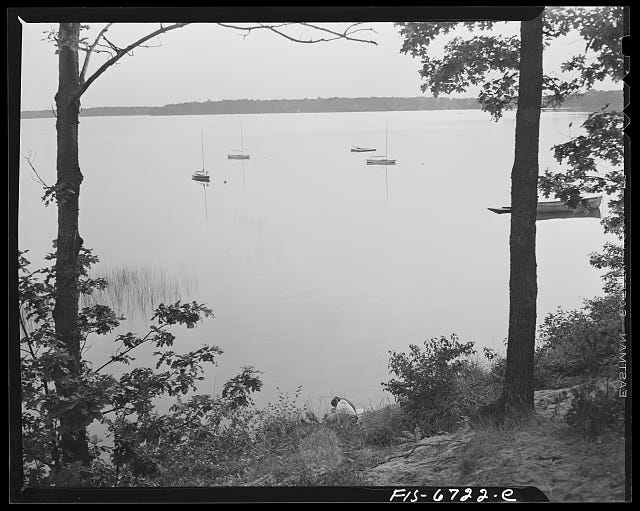
White returns to his place wondering if it is ruined or marred in any way. Somehow he expresses not fear, not concern, that this holy place could forever be altered for him, just wonderment.
On the journey over to the lake I began to wonder what it would be like. I wondered how time would have marred this unique, this holy spot--the coves and streams, the hills that the sun set behind, the camps and the paths behind the camps.
How quickly his memory re-fires and lives again in that place and time. The power of smell takes over and he encounters memories which spawn other memories. It’s an amazing feature of our lives that we can access our past in this impure filtered way. We do not see as documentary, but as fiction. Our memories are accompanied by sight, sound and smell — protected not by a realist clarity but by the truth of life that only great art can ever approximate. A truth that goes beyond what only the surface can show.
The untouched memories of childhood. How pure they are, how important to the formation of self. They become a place that you can always return to in your mind, during the darkest of days, and know that this world isn’t only filled with hate and evil, but some good exists as well.
Those memories, those places are delicate. They can be easily spoiled, quickly tarnished. If ruined, it is not just the destruction of a memory, but an entire reworking of childhood, of formation, of belief in the world’s possibility to be good and holy. Once damaged, the burden remains present and heavy. It is not just memory, but a portion of life splintered and cracked. And the one thing that should be pure, your childhood, darkens.
White’s world remained untouched and the same, though the years had stretched out. Nothing irrevocable had occurred and he slips into the place of childhood glee. Though, small subtle changes occasionally bring him back to the reality of time’s march. The new sounds of loud outboard motors and the way the path to the farmhouse now differs from when he was a boy. These small changes are not enough to offset the feel that time is static.
In his mind White transposes himself onto his son, onto his father. In this place where time is static isn’t he really the boy next to him, the one jumping in the water, carefree and hopeful as a child. Or has he now become his father? It’s an in-between state where you can feel both lives that occupy different moments in time, different planes of existence. Are you your father? Are you your son? You are caught in the middle neither the younger nor the older.
White is able to set the scene and mood and a feeling in such a short amount of time. Here he evokes the feeling of pure mid-century Americana.
Summertime, oh summertime, pattern of life indelible, the fade proof lake, the woods unshatterable, the pasture with the sweet fern and the juniper forever and ever, summer without end; this was the background, and the life along the shore was the design, the cottages with their innocent and tranquil design, their tiny docks with the flagpole and the American flag floating against the white clouds in the blue sky, the little paths over the roots of the trees leading from camp to camp and the paths leading back to the outhouses and the can of lime for sprinkling, and at the souvenir counters at the store the miniature birch-bark canoes and the post cards that showed things looking a little better than they looked.
The lake summons a nostalgia for the most classic of American experiences. Life was better and simpler. People were kinder and the fateful American Dream may still have been possible. This is one side of the nostalgia coin. The dangerous side, the unearned sentimental side filled with images representing experiences unknown and only guessed at.
Whereas, the other side of the coin, what White lived, felt, smelled and wrote about. It is those types of memories that provide a protective cocoon around who and what we are. It’s the only remembering the good, or glamorizing the struggles because in hindsight, wasn’t it all rather funny?
Once More to the Lake is an invitation to feel, to explore the roads of our own minds and substitute White for ourselves and our own special places. It does what the very best of these works can do, it makes one travel the contours of their own childhood life and memories. I only pray that these memories remain infrangible. For either way, it is an important and powerful act representing the very best that writing can do for our lives.
Read: Once More to the Lake
Next week at The Cultural Review: The Passenger by Ulrich Alexander Boschwitz