


A dinner… a conversation, it’s a simple conceit, yet done entirely without convention, and has never been matched. It speaks in the lucid intellectual way we all wish we could or would communicate with one another. My Dinner with Andre should be experienced and then shared across the burning embers of a fire, over drinks, and whatever else brings us together in communion with each other,
This is a film that has the unique ability to speak truth plainly. It speaks so profoundly that it can convey years of ennui in a few short moments. It offers one of the most poignant and damning quotes I’ve ever grappled with.
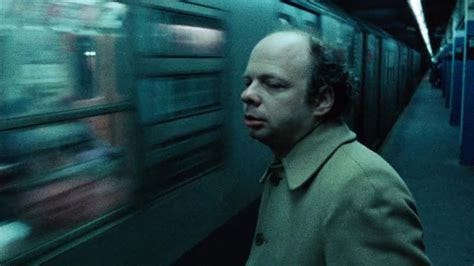
…and all I thought about was art and music. Now I’m 36 and all I think about is money.
So how does one speak about or write about a film that is not a film? It’s a captured conversation, a written dialogue… expressed in the way we wish we spoke. It’s a conversation that feels so real, and so true to late nights, and dinners, and too much wine, full of changing topics that flit between one profound moment and another. It never stops to take in the scenes but continues to propel forward with such fervor because we have so much to say and so little time, and the night is ending and we feel we could burst with all that is within us.
It transcends the idea of form and becomes a play… a film… a book, all in one, yet not quite singular. It is more about words than the images. There is almost no image beyond a face expressing feeling. But it is the faces of André Gregory and Wallace Shawn that are etched in the mind. Normal, real faces you may encounter at the grocery store. Faces and punctuation that bring words to life. Faces that mesmerize us into a tranced state.

The first half of the film is dominated by the fabulist story of André’s existential crisis. It feels like an extended John Cheever short story or the place J.D. Salinger would have reached if he continued on in the vein of Hapworth 16, 1924. While deeply compelling, the film comes more alive in the second half as it delves into the philosophical and profound.
My Dinner with Andre conveys so many ideas in so short a time. There are so many anabranching patterns and streams of thought one could follow and get lost in. The ideas are timeless and even more relevant in the now.
One of the core ideas is that of a Buddhist mindfulness. Mindfulness has been coopted by the wellness and self-help communities to an extent that the idea has almost lost all meaning. Are we capable of truly seeing ourselves and our world versus seeing what we want to see or what we’ve been programmed to see? It remains an enduring idea.
I don’t... I don’t think we’re even aware
of ourselves or our own reaction to things.
We...We’re just going around all day
like unconcious machines...
André is concerned about the decoupled consciousness. That everything in life has become habitual, planned, and performed. Authenticity has disappeared. We cannot be true with ourselves and with each other. We have become automatons. These arguments are more relevant than ever and are loudly tackled in Paul Kingsnorth’s 2026 book Against the Machine.
Kingsnorth argues we are pure materialists, disenchanted with the natural world, controlled by technology and our lust for power, wealth, and growth. Technological advances don’t always lead to human flourishing, in reality they often lead to consolidated power and wealth for the oligarchical ruling class.
During the 45 years that separate us and the film, André must have appeared insane to some viewers. A sensationalist, a hippie, a conspiracy theorist. World-wide unconscious brainwashing to control and extract money from the masses is an extreme proposition. Yet, it doesn’t feel so very far from the truth.
...that creates this boredom
that we see in the world now...
...may very well be a self-perpetuating,
unconscious form of brainwashing...
...created by a world totalitarian government
based on money...
...and that all of this is much more dangerous
than one thinks...
Kingsnorth’s ideas are echoes of André and Wally’s impassioned threads of conversation. The failed promise of the religion of science to make everything better. Or the particularly unique discussion on the merits of the electric blanket. How this piece of technology is just another form separating us from the reality of the world. It dampens and softens feeling and perception. It represents a degree of comfort that damages something within us.
I think how salmon are sensitive to their riverine environment. If the water is too warm and lacking in oxygen, they cannot survive. If it is too cold, nutrients are limited and they cannot grow big and strong. The composition and persistence of the river bottom affects if they can spawn and if their eggs can survive. We are also animals living on planet earth. We are similarly affected by changes to our environments. Yet how these changes affect us are more opaque. We are not only concerned with the simple physical act of survival. But are haunted by the emotional, the spiritual, the mental, the human.
This blessed consciousness of humanity is at the core of what My Dinner with Andre is about.
Wally follows André through this maze of intellectual argument. He pushes him forward and asks simple questions. He represents a more standard viewpoint, more of an everyman who hadn’t travelled to the desert to eat sand. And as the conversation furthers and deepens he pushes back unable to accept these definitive assertions.
I mean... I mean,
I know what you’re talking about...
...but I don’t really know
what you’re talking about.
And in some ways I agree with Wally and think that a simple life of comfort and work can exist. For life is hard enough without needing to be truly present in every moment. But I also hear what André says and fear the dark forces in this world disconnecting us from actual living. And I do wonder what could be possible within our souls and between each other if we could exist unfettered.
It’s like the question The Matrix asks, does the nature of reality matter if we are happy? Does it matter if we are batteries fueling some terrible machine? It is what Wally wonders and doubts the importance of. His world of plays and quiet nights with his girlfriend are enough for him. In some ways he doesn’t care about more than that.
We all have these created little worlds of comfort. A small circle of peace to shield us from the vicissitudes of life and fate. Most days, I just wanted to crawl into my own little world, which is often a book, and forget about the wider world that is filled with pain, and doubt, and worry. Why would we want to live mindful and present in a world like that?
But I can’t quite do that. I can’t quiet the questioning and wondering and the wishing for more. Because I do feel like there is a more present and better reality that somehow maybe someday I can unlock.
Wally and André hover above me like benign angels, neither offering heaven or hell, but different paths and approaches to life. Different lines of questioning. Some days I listen to Wally and I crawl into my cave and gather my loved ones around and feel happy for the life we have built together. For the small things, like a glass of wine with friends, a hug from my children, a shared joke with my wife. The world of film and fiction to bury my head into.
Other days André reaches down and pulls me forth. I go to war with the world. I seek answers to questions. I battle with my thoughts. I try to find ways to make it better, because it must be able to be better. There must be more.
The conversation of the film continues and it weaves back and forth between the both of them like music or dance. We can hear the sound of clinking glasses and clattering forks and knives of a restaurant. I can almost smell the dark fruit of red wine swirling around my glass as I listen to my two angels above me.
Then the camera zooms out and the restaurant is empty, reflecting the feeling of unnumbered real nights and the swirling of awareness descends, ending the communion of spirits sewn together in harmony for that briefest of time and then it’s time to go home.
Currently, you can stream this film on HBO and you can read the script here.
Next week at The Cultural Review: Martyr! by Kaveh Akbar