


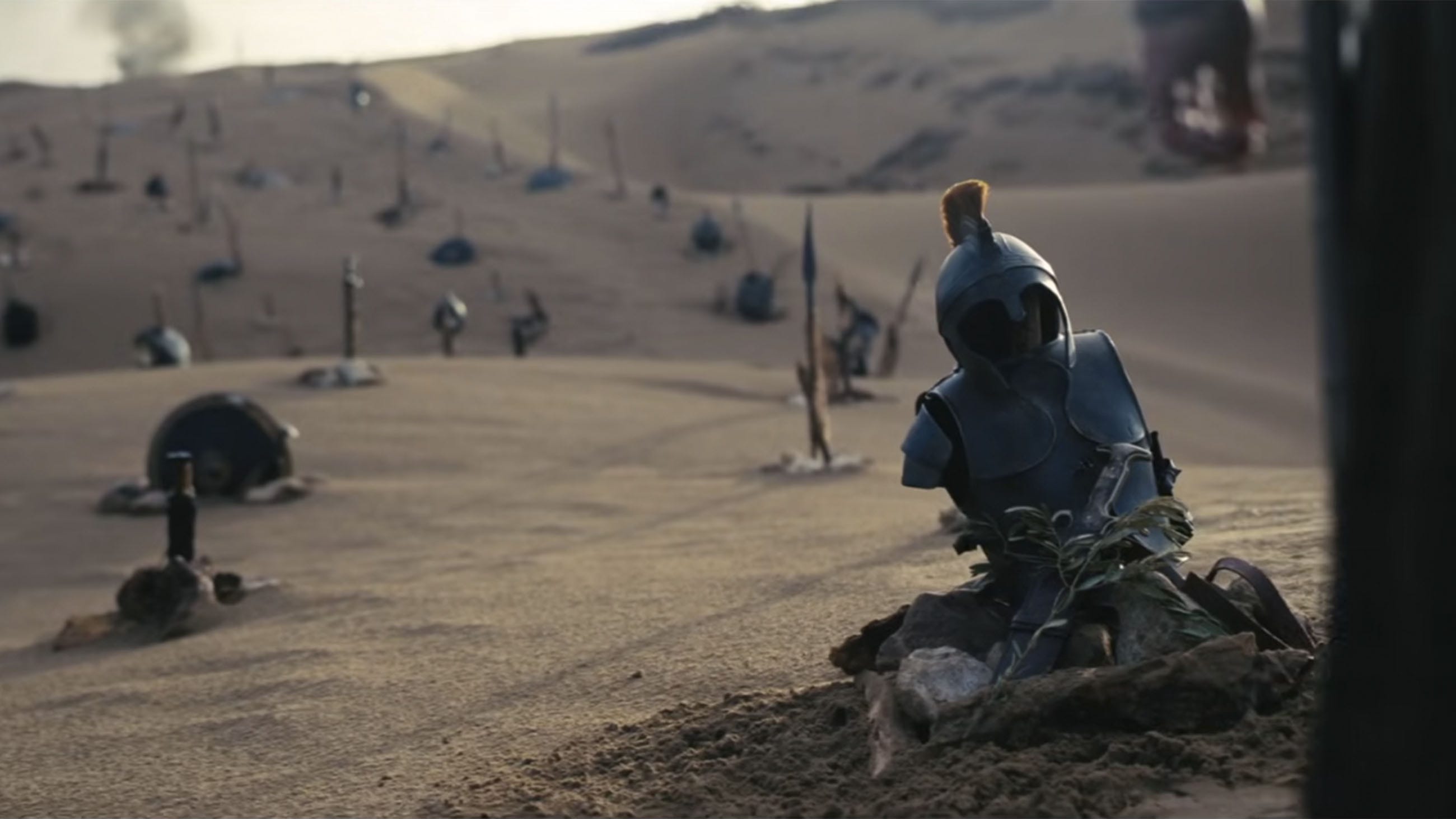
The Odyssey has sparked a flurry of opinions, takes, and thoughtful dialogue. (Add “film that launched 1,000 takes” joke here.) It has triggered the dreaded culture wars. It has made mounds of money. It has made people care about film formats. It has created a desperation to snag a seat for the holy 70mm IMAX. It has done a lot, and in short, entered the cultural consciousness in a way that is both splendid and suffocating.
One of the more interesting debates is the question of fealty to source text. Below that there is a secondary layer associated with source text translation. I do not possess the knowledge or reading to delve into translation, though I am immensely interested in that topic. What remains is the question about how accurate should a film be to its source material.
Film based on… is a long and storied history. Many of the best films ever are based on something. Think Lawrence of Arabia, Apocalypse Now, and Blade Runner. Think of the famous crashed car in Stanley Kubrick’s The Shining. Here, Kubrick specifically shows the viewer that he is breaking from Stephen King’s novel to create his own thing, his own adaptation. Following and not following a source text is as old as film itself.
This debate around helmets, race, character disposition, and accuracy reminds me of another magnificent epic, The Lord of the Rings. Peter Jackson famously adapted and filmed the impossible to film fantasy novel but not without changes and choices to better fit the medium he was working in. Frodo, arguably the most important character, is drastically different. In the film he is significantly younger, matching the age of the other hobbits. In the book he is older, more like a master and less like a friend. It is a serious character change, particularly in how the other hobbits relate to him.
Peter Jackson skips swaths of story: The Old Forest, Tom Bombadil, and The Barrow Downs. They are key components of the story and some of my favorite chapters, but I understand why he made the change. Those changes don’t materially affect the outcome of the story. Either way Frodo and the Ring still make it to Rivendell. Frodo is still injured by the Nazgul blade. The key components still remain.
Or there is the depiction of Aragorn, who would most closely resemble a classical hero such as Odysseus. In the book Aragorn is conscious of his destiny and filled with confidence in his claim. In the film they introduce doubt to the character. Aragorn questions himself and his role, he is unsure if he can live up to his lineage. He fears his bloodline’s history. This is a major change to his disposition and how he, as a character, approaches the world. This change is the most similar to Odysseus. Aragorn is given doubt and Odysseus regret.
My point here is that filmmakers make choices for a variety of reasons. Some are associated with the time constraints imposed on filmmaking. Some are related to the visual aspects of storytelling. Some are personal preference towards the story they want to tell, the adaptation they want to make. There will always be changes in a film adaptation and having a reader first mentality can make those changes hard to stomach.
However, I firmly believe change and adaptation are crucial to the process. I think they are necessary. And most of all, most importantly, they matter less if the art is good. The Fellowship of the Ring is good. It’s one of my personal favorites. It is a breathtaking achievement in filmmaking filled with practical effects that ground us in the real natural world of the story. I don’t think about the character changes and story skips when watching because it is so good on its own. I also have both the book and the film. They offer similar but different experiences that I can return to depending on what experience I would prefer.
In the same way that I believe The Fellowship of the Ring is great and transcends petty complaints, so too is The Odyssey. It is an immense piece of filmmaking that follows a similar playbook and is rooted in real locations with real practical effects. It is sprawling and immense and pure spectacle. It is good. It is good enough, for me, that debates about historically accurate helmets are meaningless. Film is fantasy, it is a dreamworld, it is not documentary, it is not exact. Why do we find ourselves expecting this out of Nolan’s latest achievement?
I don’t pretend to understand the online debates that are thriving in this “take” economy. Did I have notes? Of course, and yes, but they are not based on the simple ideas around if Helen was white, if the helmets were different, if Odysseus wasn’t regretful, would it have been a better film?
I’m more interested in how it cribs from the visual and story style of Inception. How he continues to play with time and the film is constructed as a series of characters telling stories about other characters and events. How the last lines of dialogue fall completely flat. How the battle with the suitors is incomprehensible but the moments before are breathtaking.
I don’t mean to say all this in some way that excludes criticism and debate in favor of pure fanboy praise. I don’t think that is a healthy place for our culture to go. I think I am arguing for fair and rigorous criticism for the thing itself. What I mean by that is that I don’t believe The Odyssey should be judged directly against the text. That its departures should be debated, but a departure in itself is not necessarily bad or good, it is how it serves the story of the film.
Nolan clearly wanted to use Odysseus and the events of the Trojan War to say something about our current moment. That is adaptation. You can agree or disagree with that choice and the message he is trying to convey. You can have an opinion on whether the story choice works, or if Odysseus is now wildly inconsistent. How can he regret Troy but then take pot shots at the Cyclops? But what I find disingenuous is the idea that the film must perfectly adhere to the poem. They are each their own thing.
And that is where I have landed. I saw it on a very large screen in a loud theater with a bunch of other people in attendance. I will see it again not because it’s my favorite film, not because I’m completely enraptured, but because it is spectacle and in many ways demands such.
Watch The Odyssey in theaters.
Next week at The Cultural Review: The Sunday Times Golden Globe Race