


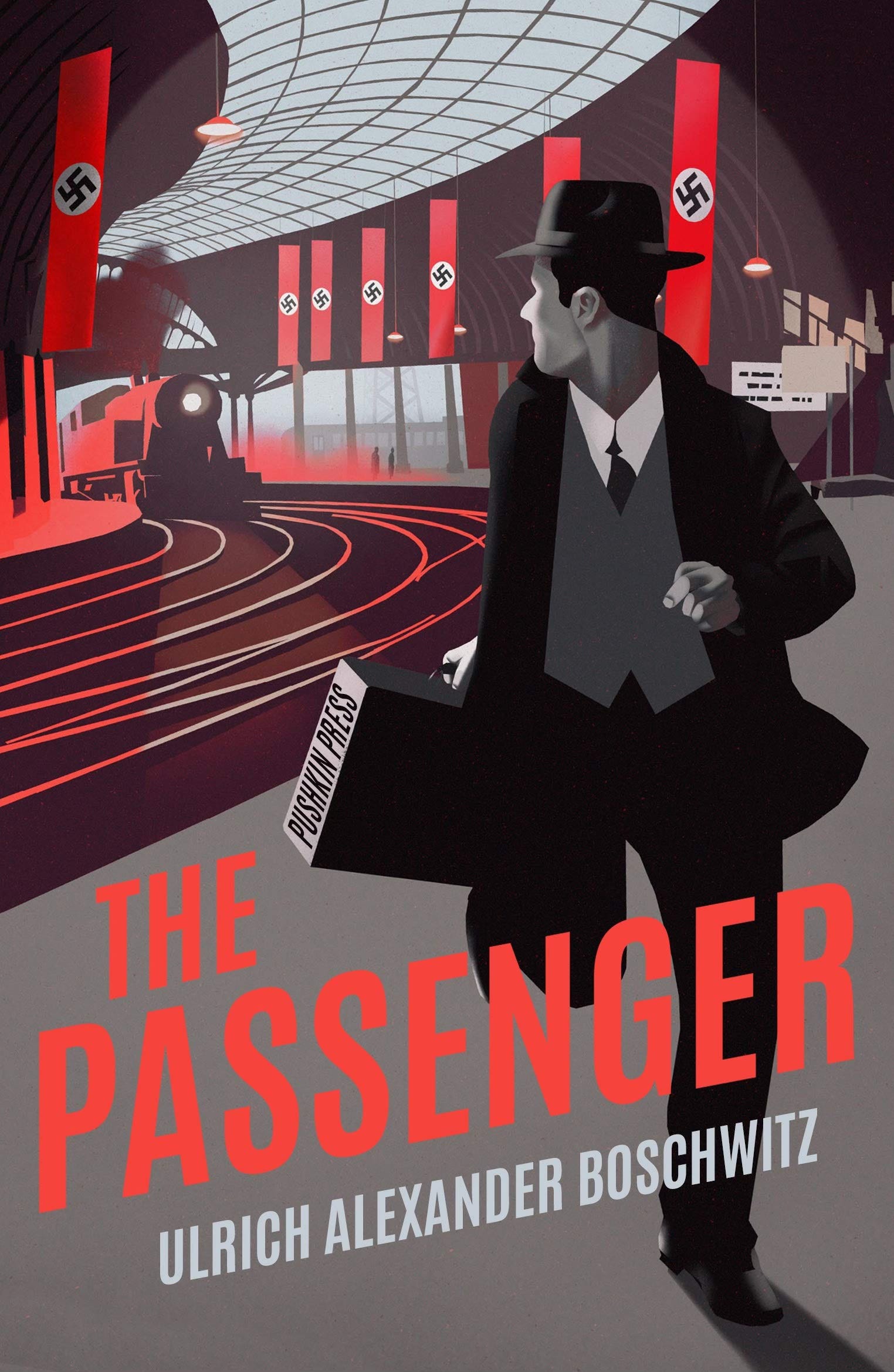
Coldly evil blonde haired, blue eyed Nazis in khaki uniforms. They are equiped with bright, red sleeved swastikas, and are breaking down doors, checking papers, hunting… always hunting for their prey, the Jews. It’s an image that saturates the popular imagination through film and story, filling countless reams of paper. It has been told so many ways and so many times; it is now trope.
In 1938, when Ulrich Alexander Boschwitz wrote The Passenger, it was not trope, but reality for six million souls across Europe. Though Boschwitz, having fled Germany in 1935 could not have imagined the extent of the horrors that would follow. It is with our hindsight that the trials of the bumbling Otto Silbermann take on a more menacing tone. For we know what happens if he is caught, we know what awaits at the concentration camps.
This knowing propels and enhances the novel. It pops with palpable stress. One reads in fits and starts, finding the tension difficult to consistently bear. There is an annoyance. A sweat on the brow and you just want to shout at Silbermann, want to speak some sense to him. “Get out! get out!” But he cannot listen, for he is just the invention of a man long dead, who tragically perished by the same fascist forces that stalked his great protagonist.
“You have to leave,” she whispered, upset.
“No, no, I can’t leave you here alone!”
No knowing what he should do, he headed toward the door. She stopped him.
“Nothing can happen to me if you’re not here,” she assured him, blocking his way. “Spend tonight in a hotel. Now be quick and go.”
He thought for a moment. The bell rang again and fist began pounding at the door.
“Open up, Jew, open up…” several overlapping voices bellowed. Silbermann’s jaw dropped. He fixed his eyes on the door.
For Silbermann is neither heroic nor competent. He is just a man forced to confront a reality and horror he cannot imagine and will not believe. That ignorance, or refusal, to accept the painful truth of an oncoming genocide builds and builds throughout the novel. For he is offered many escape routes, many paths to salvation. Somehow he botches them all. The stress builds. And it makes every bad decision feel worse.
This feeling, this stress, this frenetic pace is all mirrored in the writing. It is written in short choppy sentences. Ornamental language and flowery prose are not found. Clear, concise, ruthlessly Germanically efficient language fills the passages of this novel. At times the writing feels simple. But the overall effect is serving a greater purpose. It is driving the mood and the feeling of being on the run, of being hunted, of witnessing the destruction of all you hold dear.
Silbermann had paid his taxes; he served with honor and dignity in the First World War. He clings to these notions as proof of loyalty, as proof of citizenship. What more can a man do for his nation? But it is his blood, classified and determined by the evil and foolish “science” of eugenics, that does him in. It is only through the lucky lottery of genetics that he does not appear as a Jew and is able to silently escape, riding the trains back and forth and back and forth again. It is a futile search for freedom and leaves him with only a haunting and temporary existence in a passenger car.
It is no wonder that following this terrible war that the great and prophetic novels 1984 and Brave New World are born. For, if a man can be condemned for his blood, why can’t he be sentenced for his thoughts, his history, doomed by his genes? This hellish classification that led to mass murder seemed impossible in the elevated and educated world of the 1920s, yet it still happened. What a great and terrible reminder this serves to us.
In 2026 we wonder how war and murder and genocide still happen. We can’t conceive of a state that controls and coerces for its own bald gain. Yet it is all possible. It may be happening right now. It is easy to fall for peace and comfort in the belief of a liberal and accepting society. The Passenger is a sober reminder of what is possible in the dark hearts of humanity.
I try to imagine myself as Silbermann. As the hunted and bewildered prey of an evil and insane state. It would feel inconceivable to me. I would be unwilling to throw away my wealth, my passage through the hard-bitten world. I would likely act irrationally, behave sentimentally and foolishly.
That is part of the power of this novel. The reason it was unearthed and resurrected for a second life. That it still has power, still has meaning. It places us so singularly in Silbermann’s viewpoint that we’re able to imagine ourselves as a replacement. We are able to question his motives, but also wonder how we would respond in the same setting. This power, this conveyed substitution is what elevates the novel into something worthy of rebirth.
It is this very resurrection and age of the novel that brings questions towards perspective. Does knowing that this is first, that this is written before all that came after, before all the trope, make it more powerful? Or does it remain wholly and steadfastly able to stand on its own? I’ll never know.
The Pushkin Press edition opens with a lovely and engaging introduction which tells the story of the novel, and of Boschwitz, and places us within that historical context. It’s nearly the case that the story surrounding the novel may supersede the text itself. But that doesn’t matter. Because this perspective and story of the story is important. Don’t all the great literary works stem from a great act and story of creation? For I would have never taken the time to read this heart-palpitating novel without the background context providing such a compelling reason to read.
For isn’t that what we all need? A story and a reason to read. The world is cluttered with so much stuff, so much content. I’ve become part of the problem myself, spewing my thoughts and opinions across the open void of the World Wide Web. With so much distraction and so little time, it is only a compelling story about a beautiful story that breaks through and makes it worth the effort.
But the broader question remains. Is this novel greater because it purports an authentic experience? One that drives a feeling of importance and foundation. Isn’t being first one of the most important components, as long as the art is still good enough?
For if I read this novel with a less discerning eye, and one without the context and history, would I find it derivative? Would I find the prose simple and bland and think that it was an error in translation or a lack of artistry itself? Because a modern story about a Jew and Nazi Germany is not compelling. It treads on well-worn ground. It would be forgotten and ignored, at least by the likes of me.
It brings forth the ultimate question, the one we can never answer. Can the art, the novel, the picture, the film, stand on its own? Or does it need the context and the history and the setting and the motives of the artist itself? Or do these ornaments only take a good thing to great? I don’t know if I’ll ever know. My answer changes frequently. For sometimes it’s a resounding yes and sometimes it’s an absolute no. The answer, I suppose, depends on the work itself. In some ways, I feel like this is what makes the whole thing meaningful in the first place.
You can find a copy of The Passenger at Pushkin Press
Next week at The Cultural Review: François Truffaut’s Jules and Jim