


Yoga is a deep descent into the dazzling mind, emotions, thoughts, and life of Emmanuel Carrère. It’s part autofiction, part memoir, part something so uniquely its own that it eludes description or categorization. Carrère intoxicates with his seeming openness and honesty, which is difficult to discern from a literary trick, or the truth.
He seems to write about nothing and everything at the same time. Everything in the sense that he is writing about life, beautifully alive, complex, life. And nothing, because there is no plot, no inciting incident, no climax, just his thoughts and life strewn on the page.
New to Carrère, I find myself reaching for a familiar voice, a comparison, and inevitably land on Knausgaard. Though, I consider Carrère to occupy a different corner, a different flavor of the now scorned genre of autofiction, he and Knausgaard swim in the same sea. It is a sea of seemingly endless words and thoughts that spill out from deep indefatigable reserves of selfhood.
There is a mastery to what they do that can feel both deeply familiar and utterly foreign. It takes a true master of sentence and observation and thought to keep the reader turning the page again and again for thousands of words.
There is a trick and a sorcery to this level of writing that I cannot quite grasp. It eludes the idea of story structure and form and character. I can only but guess that it relies on rhythm of prose, an ability to instill mood and feeling that does not wither and tail off. Whatever it is, Carrère has it.
The book is centered around yoga, or meditation, and what it has meant to Carrère’s life. We follow the thread of this life, stopping here and there for brief intermissions, stray thoughts, and deeply personal revelations. It’s all pushing towards his experience at a 10-day silent yoga retreat.
Leading up to the retreat he recounts how he found himself in the world of yoga and tai chi. He explains the culture and concepts of yoga to a reporter who came to interview him. And he offers one of the most devastatingly powerful responses to those who question and doubt.
“Come and see,” Christ said to those who had heard all sorts of contradictory rumors about him, and that still seems to be the best policy: come and see, with as little prejudice as possible, or at least with an awareness of whatever prejudices you have.
“Come and see…” What a simple and profound concept. Its tendrils stretch far and extend into the many corners of life. For one does not boldly proclaim to “come and see” unless it is worthy. Unless there is an undeniable goodness that can be seen and shown. Or at least that would be my hope and I believe the hope of Carrère.
Would we hate if we saw? Would we judge? We don’t possess the purity of Christ. The same surety in mission and purpose, but still, to live an open life, an honest one, where “come and see” doesn’t terrify or embarrass, that is something.
Yoga is filled with moments, that from seemingly nowhere, fall out of the sky as drops of clarity and flakes of insight. For me, it was “come and see”. Others may find something else that strikes them like a bolt of lightning and leaves them still and reflecting. For there is much here and Carrère ranges far and wide. The only way to discover is to come and see.
Yoga and meditation, a short little book about yoga. That’s how he describes the project. That was the initial concept, but then it becomes so much more. Literary France is thrown into chaos with the 2015 Charlie Hebdo attack in Paris. Carrère is extracted from his retreat and becomes involved in the aftermath of the tragedy.
As in his own life, this moment seems to break the thread of the novel. It is no longer a quaint little book about yoga. We no longer are seated on the Zafu trying to control our breath, ignoring the burning in our shoulders and back, thoughts uncontrollably fluttering about.
We’re in the midst of a love affair, then depressed. Not just the depression or ennui of most people, but truly and deeply clinically depressed. We’re at the bottom of the well, in the dark, and no way up and out. We wake slowly from the darkness and see a Raoul Dufy painting and inexplicably we, following along with Carrère, are utterly shattered and broken and sad. And the painting begins to represent something more, a point in life, a symbol of all that can go wrong.
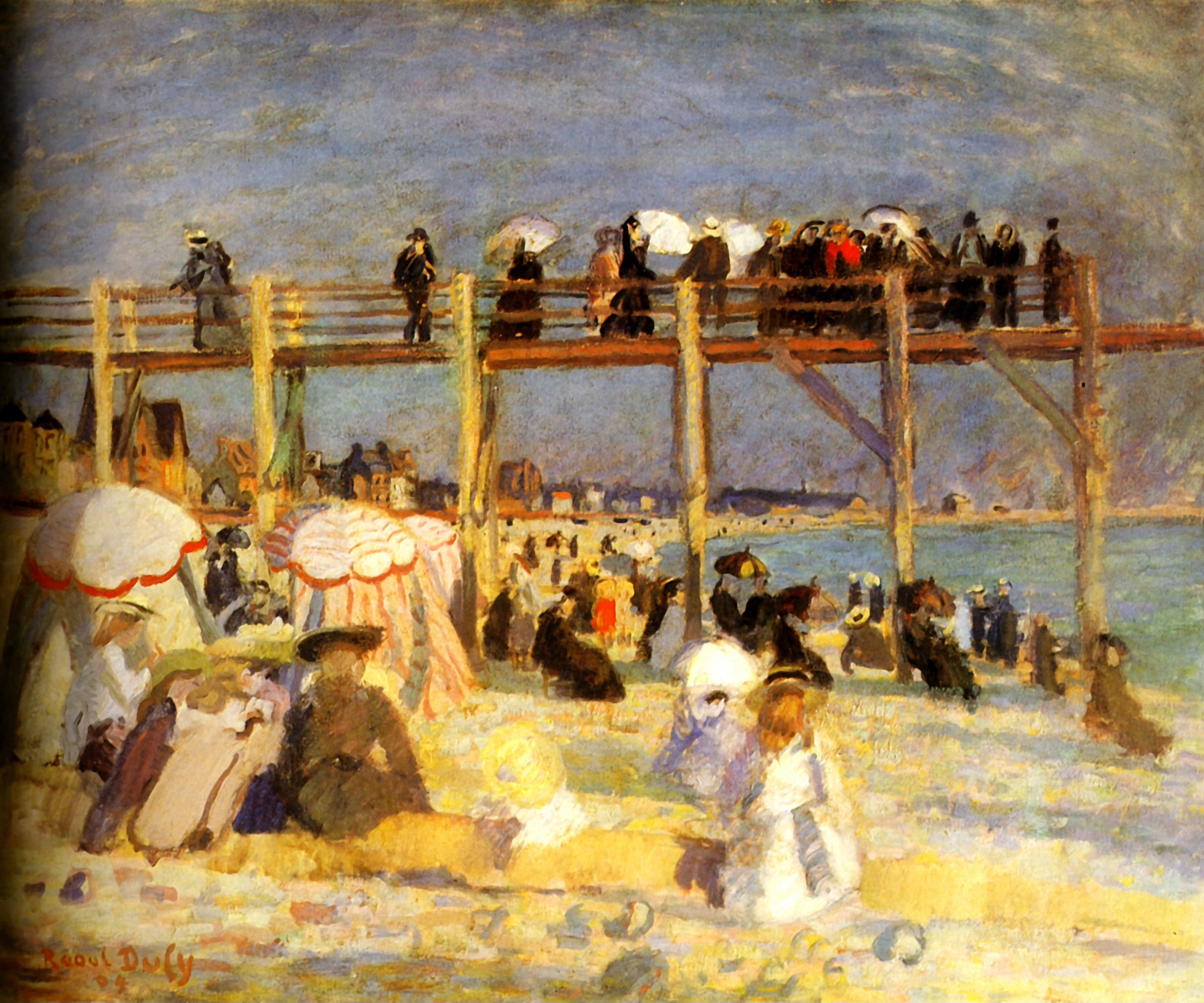
Raoul Dufy, The Beach at Sainte-Adresse (1904)

To guide one through the plot of Yoga like Virgil leading Dante through hell is to miss the point entirely. Tragedy strikes, joy is had, hope is lost and hope is found. The details of this journey, so eloquently told, are incidental to the truths surrounding the experiences. It is these elicited thoughts, so singularly one person’s glorious life, that are worth the consideration.
In the end, he questions his 30-year struggle to control and to find peace through the practice of meditation. How far has he really travelled in all this time? The control and the forced detachment is just fighting against oneself, fighting against reality, and fighting against life. By finally realizing this, Carrère is maybe finally able to feel fine. And fine is enough for him.
For he realizes that life is good. One should be happy to be alive. He is happy to be alive. And that yoga is not living. Living is living, and it is good.
Yoga is but one of many things that we use to escape life, to tame life, to control what we can control. Because it is scary to live without these crutches that hold us up. Without these things it is so easy to feel lost, adrift on a raft, subject to the buffeting winds and the moving waves and the dark currents underneath the opaque sea.
Life is really about getting wet, being lost, loving others and diving headfirst into those dark choppy waters because at the bottom we may actually find a life to live.
You can find a copy of Yoga at Macmillan
Next week at The Cultural Review: A Personal Essay